Corn Flakes may be one of the biggest cereal categories in the U.S., but it’s also one of the least scrutinized. That’s because, faced with aisles of sugary cereals with garish cartoon characters on the packages, many parents assume that the plain boxes of flakes next door must be a better choice by default. Sometimes, this is a valid assumption. Other times, however, it’s not. And it’s not for the reason you might expect.
We added 40 different Corn Flakes products to our database this month, including Kellogg’s Corn Flakes, Kellogg’s Frosted Flakes, and 38 store brand and organic competitors, and we rated them for their added sugar content. But more important than sugar content, when it comes to corn flakes, is what they do to your body after you eat them.
Where Corn Flakes Actually Came From
Corn flakes were invented at the Battle Creek Sanitarium in Michigan in 1894, not as a breakfast product but as a bland, easy-to-digest food for patients. Dr. John Harvey Kellogg ran the sanitarium; his younger brother, Will Keith Kellogg, worked under him and did much of the food development. The original formula used wheat, not corn. Will kept experimenting with the flaking process after John lost interest, switched the base grain to corn, and filed the patent that became the foundation of the Kellogg Company [5].
The brothers fell out over the direction of the business. John wanted to keep it tied to the sanitarium’s health mission and objected to adding sugar to make the flakes more palatable for a mass market. Will disagreed, left to found his own company in 1906, and built what is now the Kellogg Company around the corn flake. The falling-out is part of why “Kellogg’s” and “sanitarium health food” no longer mean the same thing.
The plain flake stayed plain for decades. That changed in 1952, when Kellogg’s launched Sugar Frosted Flakes, a version of the same base cereal coated in a sugar glaze, backed by a new mascot named Tony the Tiger. The word “Sugar” was dropped from the name in 1983 for marketing reasons, not reformulation. Frosted Flakes and Corn Flakes have shared a shelf and a mascot-free plain sibling ever since.
The Kellogg’s Lineup, Plain to Frosted
Same manufacturer, same base flake, very different nutrition panels. Here is what our database shows for the core Kellogg’s lineup:
| Product | Serving | Total Sugar | Added Sugar | Sodium | Tier |
|---|---|---|---|---|---|
| Corn Flakes (plain) | 1 cup (28g) | 2.7g | 2.7g | 200mg | C |
| Frosted Flakes | 3/4 cup (37g) | 12g | 6.2g | 190mg | E |
| Frosted Flakes of Corn | 1 cup (37g) | 22g | 12g | 190mg | E |
| Frosted Flakes with Marshmallows | 3/4 cup (29g) | 12g | 2.9g | 130mg | C |
Kellogg's flake lineup in our catalog
The plain flake is the low-sugar member of the family by a wide margin. Frosted Flakes roughly doubles to quadruples the added sugar of plain Corn Flakes depending on which submitted label you check, because Kellogg’s has run more than one Frosted Flakes formulation and package size through the years and manufacturer data on Open Food Facts reflects that variation [3][4].
One number in that table deserves a caveat. Frosted Flakes with Marshmallows lists only 2.9g of added sugar against 12g of total sugar, a gap wide enough that we don’t fully trust the added-sugar figure on that specific submission. When total and added sugar diverge by that much on a sweetened product, treat the total sugar number as the more conservative estimate of what’s actually in the bowl.
Plain Doesn’t Mean Low-Glycemic
This is the part most sugar-focused cereal content skips entirely, and it matters specifically for corn flakes because they look like the safe, boring option.
Added sugar measures what a manufacturer put in. Glycemic index measures something different: how fast a food raises blood glucose after it’s eaten. A food can have almost no added sugar and still spike blood glucose quickly if it’s made of finely milled, easily digested starch with very little fiber to slow it down. Corn flakes are close to a textbook case.
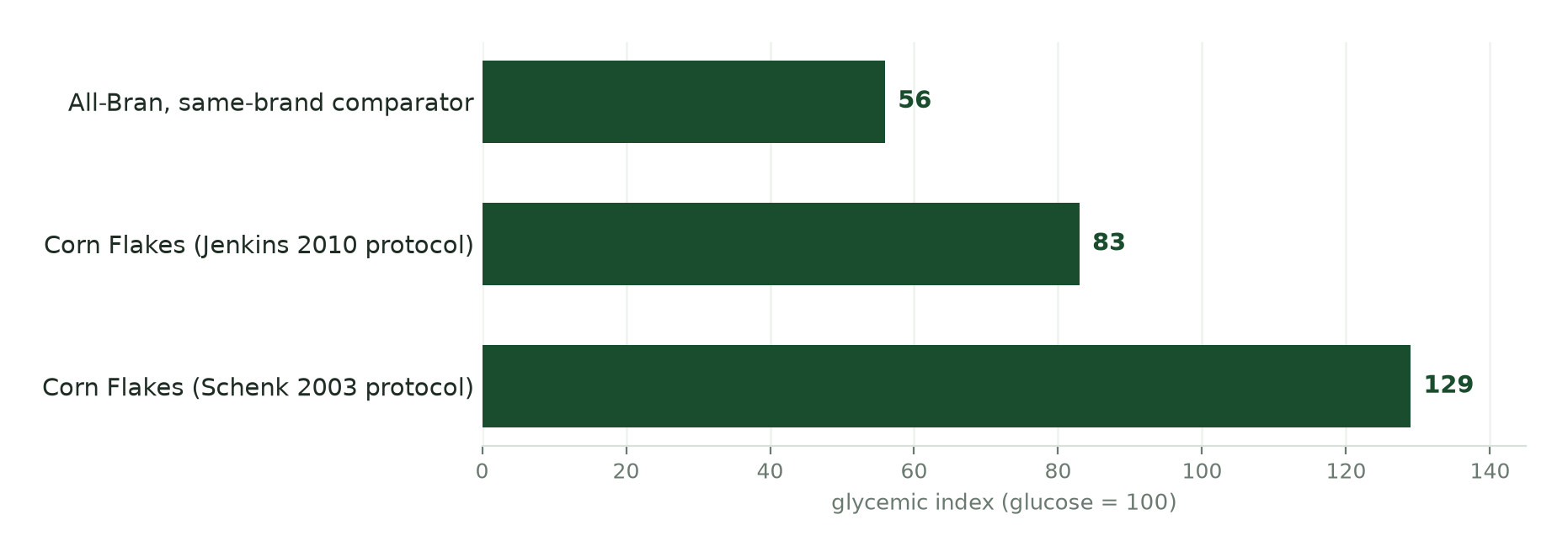
A 2003 controlled feeding trial in the American Journal of Clinical Nutrition measured the glycemic index of corn flakes at 129.3 to 131.5, more than double the glycemic index of All-Bran cereal (54.5 to 55.7) from the same manufacturer, tested in the same subjects, under the same protocol [6]. The gap wasn’t explained by how fast glucose entered the bloodstream. It came down to insulin timing: the bran cereal triggered an earlier, sharper insulin response that cleared glucose from the blood faster, while corn flakes let glucose linger [6]. A separate 1989 trial found the same directional result in young women, with 40% more area under the glucose curve after a corn flakes breakfast than after an all-bran breakfast [7].
Glycemic index numbers for corn flakes vary between studies, and that variation is itself informative. A 2010 trial measuring cornflakes as a control food (before testing an added-fiber ingredient) recorded a glycemic index of 83, using a different feeding protocol than the 2003 study [10]. Values in the 80s to 90s are closer to what most published GI tables list for corn flakes; values above 120 come from tightly controlled isolated-carbohydrate protocols. Either way, corn flakes land in the high-GI range in essentially every measurement, while the bran and oat comparators tested alongside them do not.
Why does a nearly sugar-free cereal behave like a sugar-spiking one? A 2025 analysis of grain-based foods found that total sugar was not significantly correlated with glycemic index at all. What predicted GI was the ratio of total carbohydrate to dietary fiber, meaning refined starch with the fiber milled out drives the glucose response, independent of how much sugar is on the label [8]. Corn flakes are milled corn with almost no bran or germ left in the flake, which is exactly the profile that ratio flags.
This doesn’t mean plain Corn Flakes is a bad breakfast. A separate 2007 trial found no statistically significant difference in overall postprandial blood glucose between corn flakes, bran flakes, and oat flakes when eaten as part of a normal meal rather than an isolated 50g-carbohydrate test dose, likely because milk, protein, and typical portion sizes blunt the effect measured in stricter lab protocols [9]. The practical takeaway is not “avoid corn flakes.” It’s that a low sugar number on a corn flakes box tells you less about the cereal’s overall metabolic effect than it would for most other snacks, and pairing it with protein (milk, yogurt, an egg on the side) does more real work here than switching brands.
Store Brand vs. Kellogg’s: Are the Plain Flakes the Same?
For the unsweetened product, mostly yes. Here is how the major store brands compare to Kellogg’s Corn Flakes on the metrics that differ:
| Brand | Serving | Added Sugar | Sodium | Tier |
|---|---|---|---|---|
| Kellogg’s | 1 cup (28g) | 2.7g | 200mg | C |
| Great Value (Walmart) | 1 cup (30g) | 1g | 170mg | C |
| Target Stores | 1 cup (32g) | 1g | 180mg | C |
| Meijer | 1.5 cup (40g) | 0.4g | 290mg | C |
| Trader Joe’s (Organic) | 1 cup (41g) | 5.9g | 115mg | E |
| 365 Everyday Value (Organic) | 39g | 3g | 115mg | C |
Two things stand out. First, the mainstream store brands (Great Value, Target, Meijer) run at or below Kellogg’s on added sugar, at a lower price per box, which tracks with what’s publicly known about supermarket private-label cereal sourcing from large contract manufacturers. Second, “organic” is not a proxy for lower sugar here. Trader Joe’s Organic Corn Flakes carries more added sugar per serving than Kellogg’s conventional Corn Flakes and rates our worst tier, while 365 Everyday Value’s organic version lands closer to the pack. Sodium tells its own story: Meijer’s plain flakes carry 290mg per serving, 45% more sodium than Kellogg’s, on a cereal with no sugar to mask.
Frosted Flakes: The Store-Brand Copies Are Not Identical
Unlike the plain flake, the frosted, sugar-coated versions vary widely by brand, both in serving size and in how much sugar is actually on the flake:
| Brand | Serving | Added Sugar | Tier |
|---|---|---|---|
| Kellogg’s Frosted Flakes | 3/4 cup (37g) | 6.2g | E |
| Trader Joe’s Frosted Flakes | 1 serving (36g) | 13g | E |
| Simple Truth (Kroger) Frosted Flakes | 40g | 11g | E |
| Great Value (Walmart) Frosted Flakes | 1.25 cup (41g) | 14g | E |
| Aldi Frosted Flakes | 1.25 cup (41g) | 15g | E |
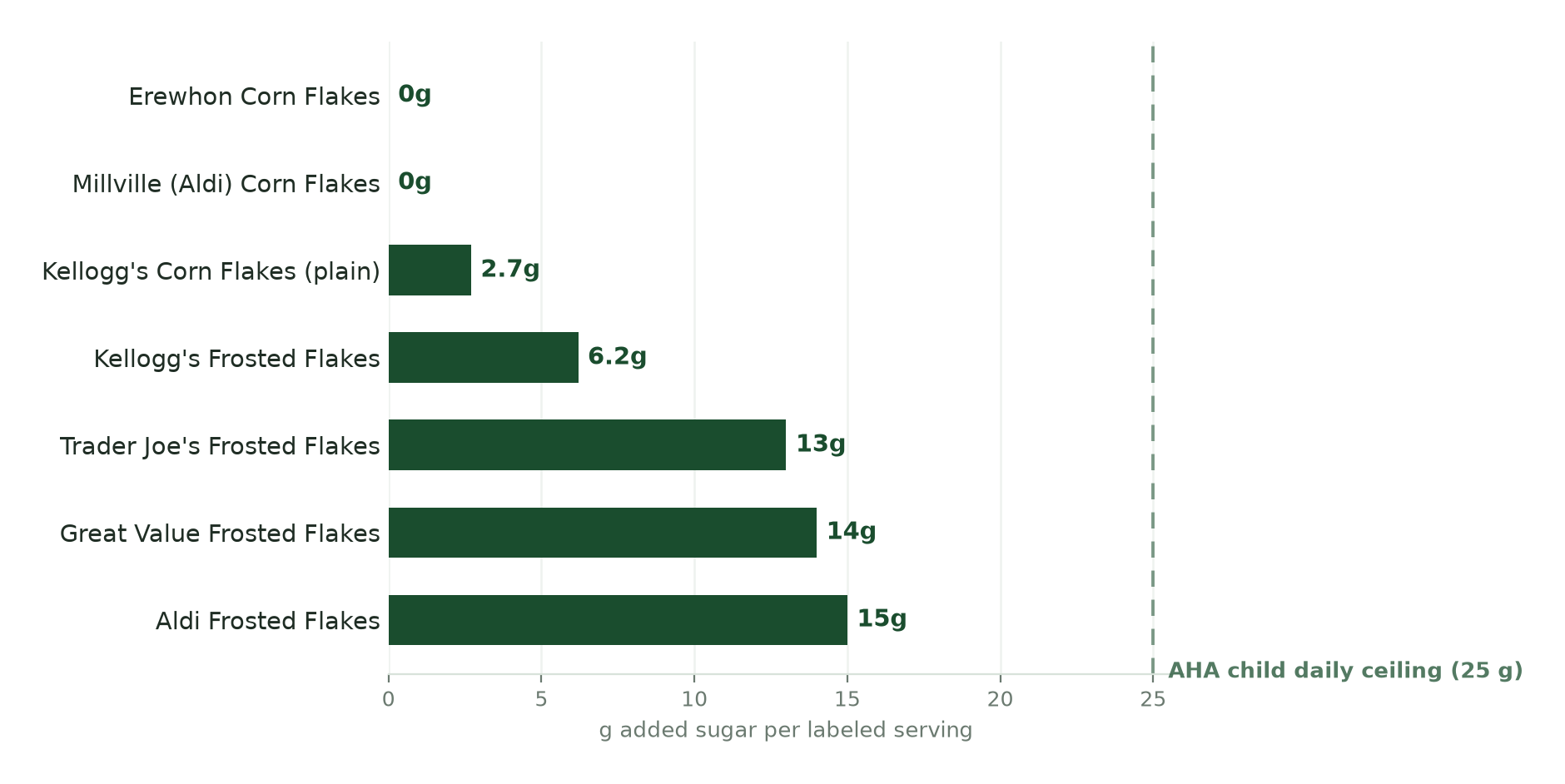
Every frosted flake in our database rates Tier E, so there is no genuinely low-sugar frosted option in this category regardless of brand. But the spread inside that shared bottom tier is real: Aldi’s version carries more than double the added sugar of the Kellogg’s submission in our database at a similar serving weight. If a child is set on the frosted version specifically, checking the actual grams on the box, not just the brand name, still changes the number by a factor of two.
The Genuinely Low-Sugar Picks
A handful of corn flakes in our database earn Tier A or B, meaning zero or near-zero added sugar with a short ingredient list:
| Brand | Product | Added Sugar | Tier |
|---|---|---|---|
| Erewhon | Corn Flakes | 0g | A |
| Millville (Aldi) | Corn Flakes | 0g | B |
| Nature’s Path | Fruit Juice Corn Flakes | 0g | B |
| Barbara’s | Organic Corn Flakes | 0g | B |
Nature’s Path’s “Fruit Juice” corn flakes uses grape and pear juice concentrate for a hint of sweetness instead of added sugar or malt syrup, which is why it still rates 0g added despite not being a plain flake. Erewhon and Barbara’s rely on minimal ingredient lists (corn, salt, sometimes malt extract) with no sweetening step at all. None of these swaps change the glycemic-index picture discussed above; they only address the added-sugar line.
Sodium Is the Metric Corn Flakes Guides Usually Skip
Plain corn flakes carry no sugar to speak of in several brands, but they are not sodium-neutral. The American Heart Association sets daily sodium ceilings of 1,500mg for ages 1 to 3, 1,900mg for ages 4 to 8, and 2,200mg for ages 9 to 13 [1]. A single labeled serving of Meijer’s plain corn flakes (290mg) uses close to 20% of a 4-to-8-year-old’s daily sodium budget before milk, lunch, or anything else that day. Kellogg’s plain Corn Flakes, at 200mg per serving, is more typical of the category. Salt is doing flavor work in a cereal with almost no sugar or fat, and it’s worth reading that line even on a box that passes the sugar check easily.
Reading a Corn Flakes Box in Under 30 Seconds
- Check whether the box says “Corn Flakes” or “Frosted Flakes.” That single word is the biggest sugar swing in the whole category.
- Find “Includes [X]g Added Sugars” on the panel, not just “Total Sugars.” For fruit-juice-sweetened versions, total sugar can look higher than added sugar for a legitimate reason.
- Note the serving size in grams, not cups. Serving sizes across our 40 products range from 28g to 41g for what is marketed as roughly “one bowl,” so gram-for-gram comparisons across brands require checking the actual weight, not the cup measurement [2].
- Check sodium if sugar is already low. It’s the second number doing real work in this specific cereal.
- If glycemic response matters for your household (a child managing blood sugar, or just wanting steadier morning energy), add protein: milk, yogurt, or eggs alongside the cereal rather than swapping brands, since the research above shows the effect is largely about the refined starch, not the brand [9].
The Realistic Verdict
Plain Kellogg’s Corn Flakes: Tier C, a reasonable everyday base. Low added sugar for a cereal, a four-ingredient label, and a manufacturer that has held the recipe close to its 1906 formula.
Store-brand plain corn flakes (Great Value, Target, Meijer): comparable or better on sugar, usually cheaper. Check sodium separately since it varies more than sugar does across these.
Frosted Flakes, any brand: Tier E. The “frosted” name is doing the same job across every manufacturer we checked. Aldi and Great Value’s versions carry meaningfully more added sugar per serving than Kellogg’s own.
Erewhon, Millville, Nature’s Path Fruit Juice, and Barbara’s: the closest thing to a zero-added-sugar corn flake on the market, with the caveat that glycemic response is a separate axis none of these swaps fix.
For more Tier A and B breakfast options beyond corn flakes, see Cereals With the Least Sugar, or browse every corn flakes product we track with full label data.